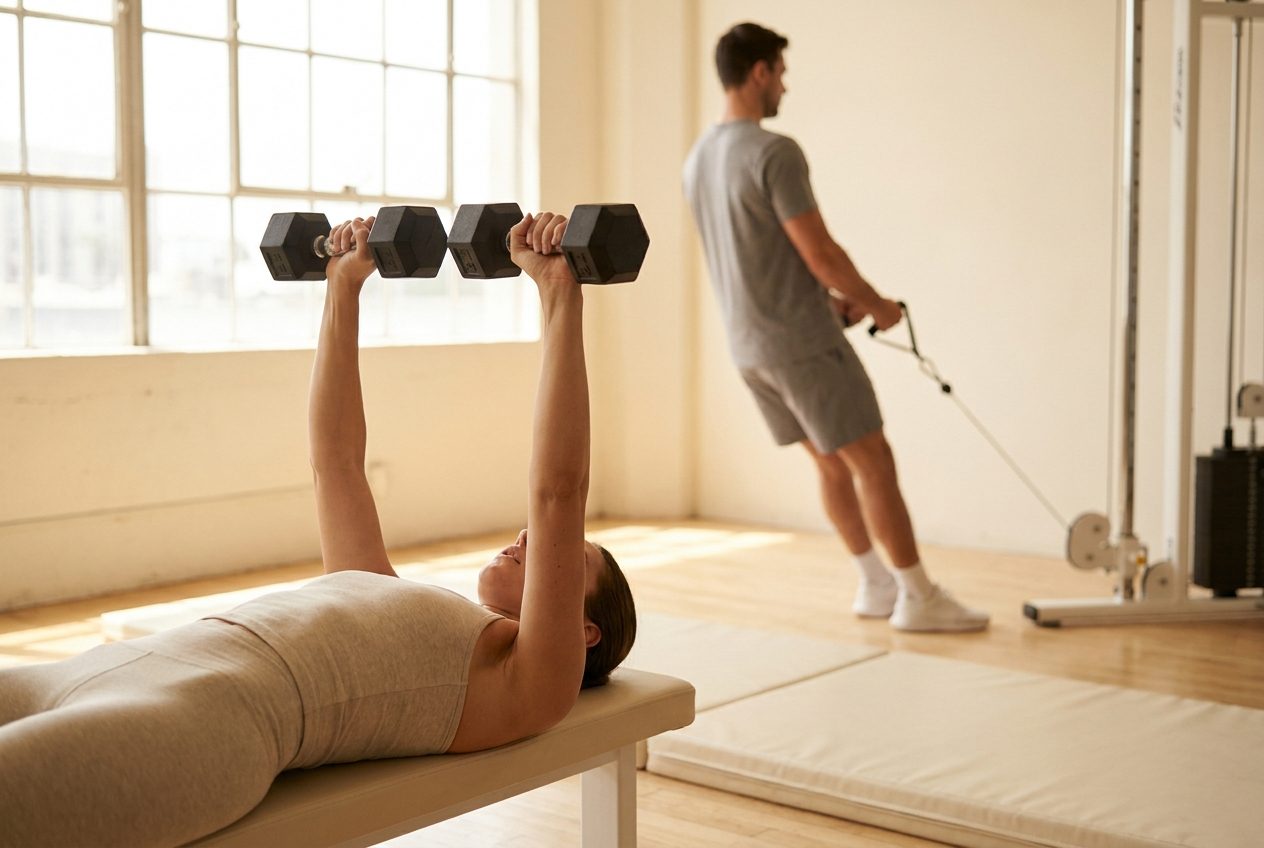
It’s a fair question: why build two apps? Wouldn’t one app with a setting be simpler? It would be simpler to build. It wouldn’t be better to use.
The honest answer is that most fitness apps already are one app with a setting, and the setting doesn’t do much. A woman signs up and gets the men’s program with lighter numbers. That’s arithmetic, not coaching. Built and Shaped differ where bodies actually differ, and share everything else.
What’s the same in both
Shaped is built on Built’s whole engine. Everything in this list is in both apps:
- Training that reads your recovery. HRV, resting heart rate and sleep, judged against your own trailing baseline rather than a population average. Two or more signals off and the day’s working weights come down, with the reason stated. No baseline yet? It changes nothing and says nothing. (The full explanation is in training by recovery.)
- Programming that autoregulates. Beat the target and it progresses. Grind it and it holds. Miss it and it backs off, from what actually happened on the bar, set by set. Programs are built around the equipment you really have: full gym, home rack, dumbbells only or bodyweight.
- Macros from real math. Calories and macros from an actual TDEE calculation, adjusted by your measured burn instead of a self-reported activity guess. Photograph a meal and it logs the macros.
- Meal plans with real portions, written day by day.
- Bloodwork, photographed and read. Shoot your LabCorp or Quest report and every marker is extracted, interpreted against athletic-optimal ranges rather than the lab’s sick-or-not bands, and flagged if it needs attention.
- A coach you can ask, that has read your logs, and weekly check-ins that are a conversation rather than a survey.
- Your numbers stay on your device. Profile, weight history, food logs, lifts and bloodwork are stored locally on your own phone, with no server-side copy. The only thing that travels is the question you ask your coach.
- Same price: $12.99 a month or $99 a year, with a 7-day free trial.
What Shaped adds
Shaped is everything in Built, plus the thing nearly every other app ignores: where you are in your cycle, and what that actually does to a heavy session.
Cycle-aware programming
Heavy work is timed to your follicular phase. Deloads are timed to where you actually are, instead of a fixed week four. Onboarding can read your last period from Apple Health, and it tells you where the date came from.
A hard luteal session isn’t a stall
This is the part that matters most day to day. The same weight feeling heavier in your luteal phase is physiology, not failure. A generic app sees a slower set, decides you’ve stalled, and quietly downgrades your program. Shaped knows the difference. Where Built might read a heavy set as a stall, Shaped reads the same set in context:
“You’re on day 24 — luteal. That set felt heavy because it was heavy today, not because you’ve stalled. Holding the target and we’ll push again next week.”
Pregnancy, TTC and postpartum
Handled deliberately and safely, rather than ignored or bluntly blocked, with programming that changes as you do.
You stay in control
If your cycle is irregular, or you don’t have one, you can turn cycle-aware programming off entirely, and the rest of the app works exactly as it would otherwise. Nothing is gated behind it.
Why not just one app with a toggle?
Two reasons.
- The differences run through everything. Cycle phase changes the programming, the deload timing and how a heavy set gets interpreted. And onboarding has to ask the questions that make that possible. Bolting that onto a men’s app as a toggle is how you end up with the arithmetic version.
- Neither should carry the other’s weight. A man using Built shouldn’t wade through cycle settings. A woman using Shaped shouldn’t be programmed as a smaller man.
The cycle apps track your phase and leave the training to you. The workout apps program you as a smaller man. Shaped does both jobs in one place, so neither has to guess.
Which one should you pick?
- Built is for men.
- Shaped is for women, and for anyone who wants cycle-aware programming. If you don’t want the cycle features, switch them off and you still have everything Built does.
Training with someone? Two on Built, two on Shaped, or one of each all work, and a Couples plan that puts two full, separate apps on one bill is coming soon, at $19.99 a month or $159 a year for two. You share a bill, not your data: each person’s data stays on their own phone, and the two apps don’t connect to each other.
What you need for either
- A phone. Both apps are on iPhone and Android. Setup takes about a minute, and then it starts asking the right questions.
- Whatever equipment you have. A full gym, a home rack, dumbbells only, or just bodyweight. The program is built around what you actually own.
- A wearable, if you already have one. Apple Watch, Oura, Whoop, Garmin, Fitbit, Withings or anything else that writes to Apple Health is read automatically. Without one, you get the same programming, macros, meals and coaching; you just don’t get the recovery adjustment, because there’s nothing to read.
There’s nothing new to buy, and nothing to re-log that your watch, ring or scale already records.
What neither app is
Both apps are natural-first strength and nutrition coaching. There’s no performance-enhancing content in either one. And neither is a medical device: the bloodwork reader and the recovery adjustments are coaching tools, and anything that worries you belongs with your doctor.
Try them
Both apps are on the App Store and Google Play, free to start with no card to try. Pick the one that fits and it’ll ask you the rest. The full feature lists are on the Built and Shaped pages.
Keep reading
Training by recovery: how HRV, resting heart rate and sleep should change today’s workout
What HRV, resting heart rate and sleep can and can’t tell you about today’s session, why your own baseline matters more than anyone’s average, and how Built and Shaped adjust the day.
Home blood tests explained: what the panels measure and how to read them
An educational guide to at-home and direct-to-consumer blood tests: sample types, what common panels measure, what a report shows, what they cost, and when to talk to your doctor.
Hitting your protein target on a busy week
A practical system for hitting a daily protein target when work, family and long shifts take over: anchor meals, a backup shelf, and a data-only example day that clears 147 g.